
Catering Website Design That Books Tastings
A catering website converts when it does three things a generic restaurant template can’t: present menus as fast, browsable pages instead of PDF downloads, speak separately to wedding couples, corporate planners, and party hosts, and turn appetite into a tasting request with date and headcount attached. Add visible food-safety credentials and real reviews, and the inquiry arrives half-sold. WebEngine builds it all on one flat monthly plan — hosting, maintenance, and a live review widget included.

New Business Website
A professional website built for your business — design, hosting, security, and reviews handled for you.
- Custom professional design
- Hosting & security included
- Mobile-first & fast
- Live review widget built in
Website Support
Already have a website? We keep it updated, secure, fast — and make your changes for you.
- Updates, backups & security
- Content edits done for you
- Speed & uptime monitoring
- Works with sites we didn’t build
What a Catering Website Actually Has to Do
Catering is hired twice: once by the imagination — can I picture this food at my event? — and once by the spreadsheet — does this caterer fit the date, headcount, venue, and budget? The website has to win both hires, usually from a phone, often weeks before you ever hear a voice.
Make the food do the talking
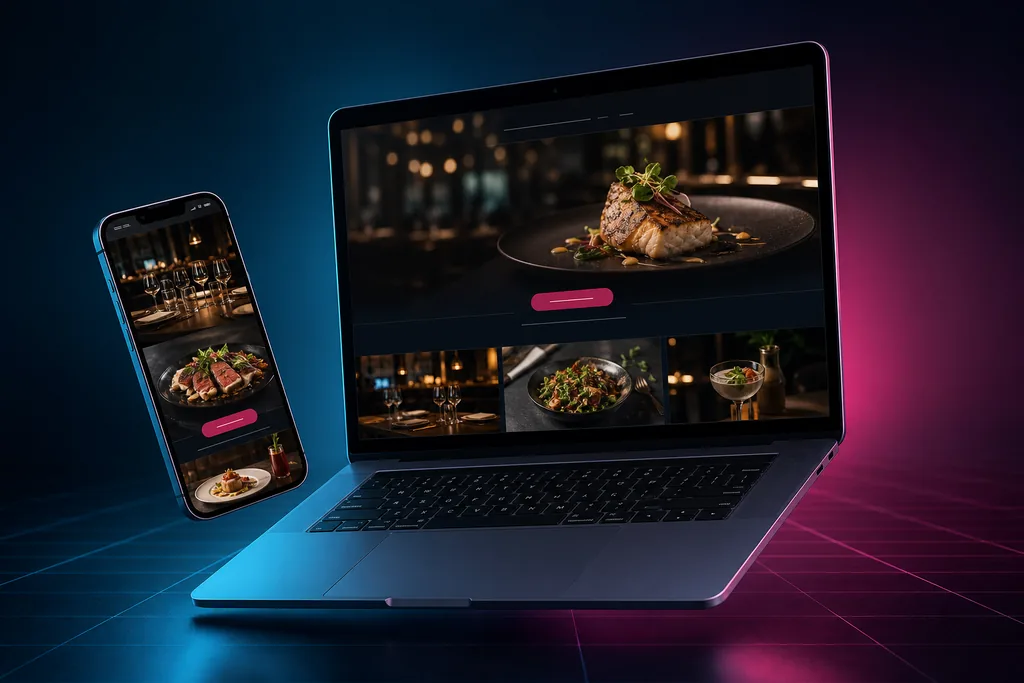
The single most-visited thing on any catering site is the menu, and it deserves better than a scanned PDF. Menus built as real pages load instantly, read beautifully on phones, update in minutes when the season turns, and rank in search — four things a PDF fails at simultaneously. Pair them with photography of your actual dishes and your actual service, because event hosts can smell stock photography, and what they infer from it is exactly what you’d fear.
Speak each event’s language
A bride planning a plated dinner for 150, an office manager ordering Friday lunch drop-offs, and a parent throwing a graduation party are asking different questions in different vocabularies. One “services” page mumbles at all three; dedicated event-type pages — wedding catering, corporate catering, social events, drop-off — answer each buyer specifically and rank for each search separately. This is the structural decision that does the most work on a catering site.
Convert appetite into a tasting
For full-service events, the tasting is where caterers close — nobody signs a wedding contract without tasting the food. The website’s job is to make requesting one frictionless and to arrive at that tasting already informed: date, venue, headcount, service style, and dietary needs captured in the inquiry. For drop-off and corporate work, the conversion is a quote request with the same discipline. Either way, the form is your first site visit, performed automatically.
Must-Have Features for a Catering Website
These are the features that turn browsing into booked events. Every WebEngine catering build includes them.
Menus as pages, organized the way clients shop
Stations, plated dinners, buffets, hors d’oeuvres, dessert, bar service — organized by service style and event type, with dietary notes (vegetarian, vegan, gluten-aware) marked inline because every modern event has them. Seasonal menus get dated so freshness is visible. A downloadable PDF can sit beside the page for planners assembling proposals, but the page is the menu; the PDF is the souvenir.
Event-type pages with proof attached
Each event page pairs the pitch with evidence: photos from real weddings or corporate events you’ve served, the service styles you offer for that event, sample menus, and a review from that kind of client. A corporate planner reading a corporate page with corporate proof moves to inquiry; the same planner reading a generic page keeps shopping.
Licensing, food safety, and insurance — the credentials that win contracts
Here is the trust issue specific to catering that most websites bury: you operate under a health-department permit tied to a licensed commercial kitchen, you likely hold a food manager certification, and you carry liability insurance — and the clients with the biggest budgets are precisely the ones who check. Corporate procurement teams, venues with exclusive-or-approved caterer lists, and government or school clients routinely require proof of permit and insurance before a contract is signed. Meanwhile, every market has informal home-kitchen operators quoting low against you; your credentials are the difference, but only if buyers can see them.
So we give them a home on the site: the jurisdiction that permits your kitchen, your food-safety certifications, a plain statement that you’re insured and can furnish certificates of insurance to venues — the document every venue asks for and every unlicensed competitor can’t produce. Allergen handling deserves a sentence of honest policy too: stating how you flag and manage allergens signals professionalism to the planners for whom it’s a genuine fear. Requirements vary by state and county, and we’re web designers rather than food-safety regulators — confirm specifics with your health authority — but if you’ve earned the credentials, the website should be wearing them.
An inquiry form that quotes faster
Event date, venue (booked or not), guest count, service style, budget comfort, dietary requirements. Six fields that transform your response from “tell me more” to an actual proposal — and that filter the 30-person backyard party from the 300-person gala before you’ve spent an hour on the phone. Tasting requests ride the same form for full-service events.
The working parts
- A service-area statement — the cities and venues you actually travel to, so out-of-range inquiries never reach your inbox.
- Real photography over stock — your stations, your platters, your staff mid-service; imperfect and real beats glossy and borrowed.
- Reviews beside the decision — event hosts’ words on the event pages, plus live Google reviews via the built-in Bird Local widget.
- Mobile-first speed — menu browsing happens on phones in spare minutes; a slow menu is a closed one.
- Venue partnerships made visible — if you’re on approved lists at local venues, say so; it’s a credential and a search magnet.
Local SEO for Caterers: Showing Up When the Date Is Set
Catering searches arrive with intent attached — a date exists, a headcount exists, a budget is forming. The caterers who capture that intent built their local presence before the search happened.
One profile, many event searches
A complete Google Business Profile in the catering category anchors the map presence, but the event-type pages do the rest: “wedding caterer [city],” “corporate catering [city],” and “drop-off catering near me” are separate searches that one homepage can’t cover. Each event page, with its on-page menu text and real photos, gives Google a specific answer to a specific search — this is where PDF-menu caterers silently lose.
Venues are your link network
Every venue with an approved-caterer page, every planner who credits vendors, every photographer’s blog post from an event you served is a potential mention and link — the kind of local relevance signal money can’t buy directly. The website makes you linkable: a clean page for each venue relationship gives partners something specific to point at.
Reviews after every event, honestly earned
Catering has a natural review moment — the day after the event, while the compliments are still arriving. A consistent ask turns that into a steady review stream that feeds both map rankings and the live widget on your site. Expect the compounding to take months; anyone promising a caterer instant rankings is serving something reheated. Our local SEO service covers the long game.
Design Psychology for Caterers: Appetite First, Assurance Close Behind
Food sells emotionally and gets bought procedurally. The design has to serve both moments.
- Lead with the food, full-width and real. Appetite is the fastest emotional response on the web; one great photo of your short ribs outsells three paragraphs about passion for hospitality.
- Keep the menu one tap away, always. It’s what every visitor came for; burying it under “services” costs inquiries.
- Answer the host’s quiet fears in place. Dietary handling on the menu, staffing and setup on the event pages, credentials near the inquiry — assurance placed where the doubt occurs.
- Show service, not just plates. Photos of your team mid-event tell a planner the day will run smoothly — the half of catering the food photos can’t prove.
- One clear ask per audience. “Request a tasting” for celebrations, “get a quote” for corporate — both visible, neither generic.
What Does a Catering Website Cost?
The qualitative market picture — typical patterns, not quotes.
- DIY builders: a monthly subscription plus your own nights and weekends formatting menus, building event pages, and wiring up forms — recurring labor, because menus never stop changing.
- Freelancers: typically a mid four-figure build with updates billed hourly after launch — which in practice means the fall menu goes live in November.
- Agencies: hospitality-grade work at retainers sized for restaurant groups, rarely for an independent catering kitchen.
The WebEngine model: one flat monthly plan
One flat monthly plan covers a professional catering site with hosting, security, ongoing maintenance, mobile-first menu pages, SEO foundations, and the Bird Local review widget built in — and seasonal menu updates are part of the deal, not an hourly ticket. Everything included is on our Web Design page.
Common Mistakes Catering Websites Make
- The PDF-only menu. Unreadable to Google, clumsy on phones, and stale by June. The most expensive lazy decision in catering web design.
- One page for every event type. Weddings, corporate, and social are different buyers; a blended pitch convinces none of them.
- Stock food photography. Hosts notice, and what they conclude — that the real food isn’t photogenic — is worse than an imperfect real photo.
- Hiding credentials you paid to earn. Permits, certifications, and insurance win the corporate contracts; invisible credentials win nothing.
- A bare contact form. No date, no headcount, no venue — every inquiry starts a twenty-question email chain instead of a quote.
- No service-area statement. You either field inquiries from two hours away or lose locals unsure you’ll come to them.
- Letting last year’s menu linger. A dated menu suggests a dated kitchen — fatal in a business sold on freshness.
Catering Website Design FAQs
How much does a catering website cost?
In qualitative market terms: DIY builders run a monthly subscription and leave menu presentation, event pages, and inquiry handling to you; freelancers typically charge a mid four-figure project fee with menu updates billed hourly afterward — painful for an industry whose menus change seasonally; agencies quote more still. WebEngine builds catering websites on one flat monthly plan with hosting, maintenance, and a live review widget included — see our Web Design page for the full list.
What should a catering website include?
Menus presented as browsable pages rather than PDF downloads, separate pages for the event types you serve — weddings, corporate, social, drop-off — photography of your actual food and service, a clear service-area statement, your licensing and food-safety credentials, a tasting request path, and an inquiry form that captures date, headcount, venue, and service style. The menu gets you considered; the event pages and the tasting get you hired.
Should caterers put menus on their website as PDFs?
Menus belong on the page as real text, with PDFs offered only as a download for planners building decks. On-page menus load instantly on phones, where most browsing happens; they’re readable by search engines, which is how ‘wedding caterer [city]’ searches find you; and they’re updatable in minutes when the season changes. A PDF-only menu is invisible to Google, awkward on mobile, and almost always out of date.
Should a caterer list prices on the website?
Most caterers land on per-person starting ranges or ‘menus from’ framing rather than full price lists, because event pricing genuinely depends on headcount, service style, and season. What matters on the website is giving planners enough signal to know whether you fit their budget tier before they invest in an inquiry — total silence wastes everyone’s time, and false precision creates disputes. We design the menu pages around whichever pricing posture matches how you quote.
How do caterers get found on Google?
Catering searches are local and event-specific: “wedding caterer [city],” “corporate lunch catering near me,” “drop-off catering [city].” Winning them takes a complete Google Business Profile, on-page menus and event-type pages that use those phrases naturally, venue relationships that turn into links and mentions, and steady reviews from event hosts. It compounds over months — be skeptical of guaranteed rankings — but catering inquiries from search arrive with dates and headcounts attached, which makes them some of the best leads in the business.
Should my catering website show health permits and food-safety credentials?
Yes — visibly. Caterers operate under health-department permits for a licensed commercial kitchen, and most states require a certified food protection manager on staff; corporate clients and venues frequently require proof of both, plus liability insurance, before contracting. Naming your permit jurisdiction, certifications, and insurability on the site answers the diligence question before it’s asked and separates you from the unpermitted home-kitchen operators quoting against you. Requirements vary by state and county, so confirm specifics with your local health authority — but if you hold the credentials, hiding them is a marketing mistake.
How long does it take to build a catering website?
Most WebEngine catering sites launch in a few weeks. The variables are usually on the kitchen’s side: menu decisions, food photography worth publishing, and how you want tastings and inquiries to flow. Caterers with current menus and a folder of real event photos move fastest — and because menu updates are covered under the plan, seasonal changes never wait on a developer.
Explore More
Caterers work shoulder-to-shoulder with industries we also build for. See our full web design services, browse every industry we serve, or visit your neighbors: restaurant website design, wedding venue website design, and food truck website design.
Ready for a Website That Fills the Calendar and the Kitchen?
Somewhere nearby, a planner with a date and a headcount is comparing caterers on her phone. Get the site with the menu she can actually read, the event page that speaks her language, and the tasting request she can send in ninety seconds. One flat monthly plan, everything included — details on our Web Design page.
New Business Website
A professional website built for your business — design, hosting, security, and reviews handled for you.
- Custom professional design
- Hosting & security included
- Mobile-first & fast
- Live review widget built in
Website Support
Already have a website? We keep it updated, secure, fast — and make your changes for you.
- Updates, backups & security
- Content edits done for you
- Speed & uptime monitoring
- Works with sites we didn’t build